Over the past few months, Grid Insight has moved beyond Itron ERT-equipped utility meters and turned our attention toward Badger ORION water AMR endpoints. Of those we have tested, both in our lab and in several municipal field deployments, we have found all to follow the same modulation, data encoding, packet structure, and data validation scheme.
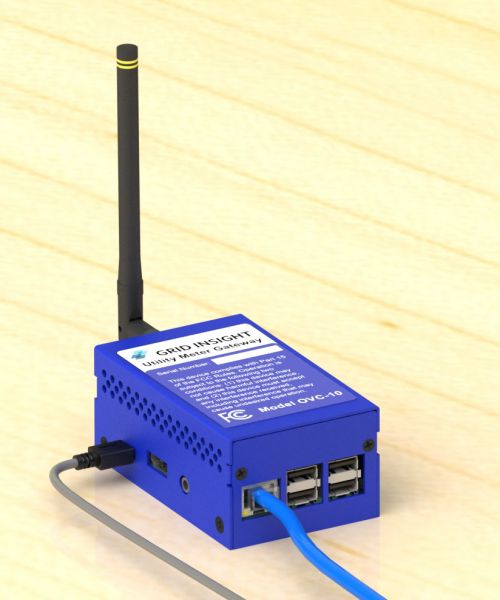
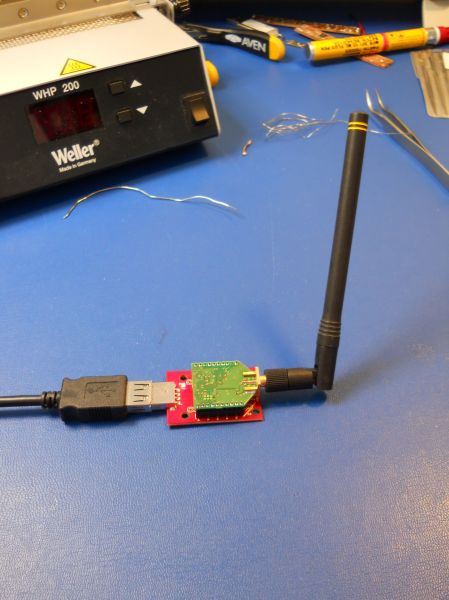
Keeping with our strategy of providing the simplest, lowest-cost solution for AMR reception and decoding, we have been able to adapt our inexpensive AMRUSB-1 "USB dongle"-style hardware platform to receive and decode signals from Badger ORION water meter endpoints. We are not yet in a position to offer these units for sale to end-users, but we are willing to work with system integrators who would like to evaluate this technology for possible inclusion in an Advanced Metering Infrastructure product. Receive range of our prototype is around 250 feet through open space in a noisy RF environment, though the range may be increased through enhancements to the hardware platform. Similarly, the receiver and decoder may be modified to run on a variety of inexpensive highly-integrated receiver and microcontroller platforms should the USB interface not be appropriate.
Obvious uses for these new AMR receive and decode capabilities include:
For more information, please contact us.
We believe our method of receiving transmissions from Itron ERT-equipped smart meters represents a new market-shifting invention by enabling reception of ERT signals at significantly lower cost than is possible with the FPGA solution available from Itron. That's why we have filed a patent application covering the technology with the United States Patent and Trademark Office.
The AMRUSB-1, the first product to employ this technology, consists of little more than a single-channel, frequency-agile integrated receiver and a PIC microcontroller with USB interface. This simple design allows us to keep parts cost down and ultimately produce a product capable of receiving ERT signals at a price point significantly lower than anything previously available.
Licenses for our patent-pending "Method For Reception Of Frequency-Hopping Spread Spectrum Radio Transmissions When Hopping Frequencies Are Not Known" are available to hardware manufacturers and system integrators, as are our firmware source code and hardware designs. Please contact us for more information.
Out of curiosity, I recently spent some time banging keywords into Google Insights for Search and Google Trends, two tools that provide charts showing the popularity of certain terms in search queries and news reports. Of the numerous themes I explored, the trend that surprised me the most is the apparent waning of interest in green technology (a.k.a “cleantech”). Take, for example, the following search terms and phrases: “bike commuting”, “home solar”, “solar installation”, “home wind power”, “biofuel”, “hybrid car”, “plug-in hybrid”, “electric car”, and “prius”. In Google Insights for Search, each of these terms showed a dramatic peak in search interest in the summer of 2008, with declining interest ever since.
I don’t pretend to be able to determine the cause, but I am happy to speculate and talk about correlation.
First, note that President’s Obama’s election campaign was running throughout 2008, with perhaps its most active period being the summer of 2008 – the same time period in which interest in so many green technologies peaked. It seems that after the election, consumers’ active interest in cleantech solutions has faded.
Also in 2008, interest in the search terms “foreclosure” and “mortgage default” peaked, most dramatically in the United States. A few months later, early in 2009, searches on “loan restructuring”, “loan relief”, “repossession”, “mortgage rates”, and even “cheap recipes” jumped dramatically. Were people feeling an economic pinch and losing their interest in green technologies because they no longer had money to pay for them? Searches for “mutual funds” seem to have stabilized at roughly half their pre-recession levels.
Those without mortgage trouble seem to have become worried at the same time debtors were growing distracted, because the search phrases “gold bullion”, “civil unrest”, “ar-15”, and “9mm” jumped. Interest in the phrase “underwater mortgage” jumped up from near zero in 2008 to spike in early 2009, then spike at yet higher levels in 2010.
More mundane, yet practical green technologies seem to have had more staying power. Interest in the phrase “energy efficient”, for example, didn’t drop off until the summer of 2010. Perhaps that is due to the widely understood notion that energy efficiency saves money, whereas alternative energy, at least without subsidies, may not.
I’ll leave you to draw your own conclusions. You can access Google Insights for Search directly and run your own queries.
I didn’t just explore green tech. People’s search habits can say something about the state of society too. For example, interest seems to be stagnating, rather than rising, for things one would expect to see associated with a rise in frugality. Some examples are inexpensive family games typically viewed as budget entertainment, e.g.: “chess”, “backgammon”, “jigsaw puzzle”, and “cribbage”. Perhaps this is due to continued mortality of the elderly, those who grew up on such low-tech diversions. If search trends are an indicator, perhaps the budget entertainment void has been filled by Facebook and Twitter, both of which have experienced rising interest in the past two years.
I also observed a worrying trend that reflects a deep-seated lack of confidence in society as a whole: an uptick in searches related to the a fringe survivalist movement, aspects of which are often associated with anti-government militias. Even while interest in practical survival and firearms-related topics like “wilderness survival”, “first aid”, and “hunting” have been dropping off, “ammo”, “223”, “12ga”, “remington buckshot”, “pump shotgun”, “home defense”, “survival weapon”, and “survival knife” are well-above pre-recession levels. Such sustained interest in weapons and ammo while interest in hunting and wilderness survival decreases leads me to conclude that a lot of people are hoarding guns and ammo, or at least would like to do so. Moreover, they are the sort of people who search on the term “ammo” rather than “ammunition”, as the trends for these two words show very distinct shapes (searches on “ammo” remain elevated, while interest in “ammunition” is down to its pre-2008 levels).
This is all very interesting, though regrettably not terribly actionable. That is, unless you are trying to decide whether to invest in cleantech or ammunition companies. Do with it what you will.
Here's a quick report on the Grid Insight AMRUSB-1 and Google PowerMeter integration. I've made excellent progress building a general purpose Google PowerMeter client library in C, which will be useful to me but also useful to anyone else who wants to get data into PowerMeter with minimal hassle. I didn't even look at the Microchip C reference code, instead just working from the Google's docs. The result will be a GPL-licensed Google PowerMeter C client library suitable for running on PCs, in contrast with the Microchip library which was intended for use on embedded devices. I think I'm going to call the library "libgoogpm", for lack of a better name. Suggestions, however, are welcome.
Libgoogpm depends on two things: libcurl for HTTP(S) interactions with Google, and the Mongoose embedded HTTP server. Both are open source packages with GPL-friendly license terms.
After 24 hours of usage of an early alpha version of the libgoogpm library integrated with one of my AMRUSB-1 utility meter data receivers, I have a power profile for my Lenovo X61 tablet and my external NEC LCD2090UXi LCD panel, both of which are being powered in my lab through a metering test harness running an Itron Centron C1SR R300 HP watthour meter.
Here's a screenshot of the result:

This integration is certainly not done, but it is working fine so far.
It's worth noting that I'm feeding only the Itron meter's standard consumption messages (SCM) to PowerMeter. The Itron C1SR R300 meter, however, is one of Itron's newer models and also provides interval data. The libgoogpm will eventually support batch uploading of interval data, so it will be interesting to see how switching over to IDM messages at that point might change the PowerMeter chart. At the very least, using IDMs will allow my AMRUSB-1 host PC to only have to process data from the AMRUSB-1 a few times a day, which means I can let that PC sleep most of the time rather than leaving it powered up simply to process power data. (Seems to defeat the point a little, you know?)
I'll be posting libgoogpm to the web site once I have it completed. There's still a fair amount of work to do on the embedded web server piece, so it could be while longer.
This nine-minute video walks you step-by-step through the Windows XP installation and verification process for the AMRUSB-1 Utility Meter Data Receiver.
To better help beta testing, customers, and potential customers understand the AMRUSB-1, I will be posting a series of screencasts on a variety of topics. The first one simply shows how to connect to the AMRUSB-1 from a Linux host using the AMRUSB-1's native serial interface. I also demonstrate some of the receiver's basic diagnostic commands.
This video and others will be archived here:
In case you find yourself doing GPS development, or something similar, and need to compute some NMEA 0183 sentences for testing, the source code below will get the job done. Compile with your favorite ANSI C compiler. Tested on Linux with gcc.
/* NMEA 0183 Checksum Calculator Copyright (C) 2011 Gregory Hancock / Grid Insight (www.gridinsight.com) This is free software; you can redistribute it and/or modify it under the terms of the GNU General Library Public License as published by the Free Software Foundation; either version 3 of the License, or (at your option) any later version. This software is distributed in the hope that it will be useful, but WITHOUT ANY WARRANTY; without even the implied warranty of MERCHANTABILITY or FITNESS FOR A PARTICULAR PURPOSE. See the GNU Library General Public License for more details. You should have received a copy of the GNU Library General Public License along with this software; if not, write to the Free Software Foundation, Inc., 51 Franklin Street, Fifth Floor, Boston, MA 02110-1301 USA */ /* Usage: Pipe your message in, terminated by a linefeed. Program will output a proper NMEA sentence, including trailing checksum. Example: user@pegasus:~$ echo UMMSG,ERROR | ./compute-nmea-checksum $UMMSG,ERROR*35 For more information on NMEA 0183, buy the spec, or read the Wikipedia page: http://en.wikipedia.org/wiki/NMEA_0183 */ #include <stdio.h> int main(void) { char c; char checksum = 0; fputc('$', stdout); while('\n' != (c = fgetc(stdin))) { checksum = checksum ^ c; fputc(c, stdout); // fprintf(stdout, " %2X - %2X\n", c, checksum); } fprintf(stdout, "*%2X\n", checksum); return 1; /* SUCCESSS */ }
I'm just so tickled at our new AMRUSB-1 device enclosure solution that I had to write about it.
I have had in the back of my mind for months the following to-do item: come up with a clean, cheap, durable enclosure for the AMRUSB-1 Utility Meter Data Receiver. I had talked to packaging people, walked through consumer electronics stores checking out how other manufacturers package their USB devices, and browsed the Web looking for ideas. Then it came to me: heat-shrink tubing.
Well, I'm here to say that it works, it's cheap, and it's bomb-proof. And it can even be colorful.
I know it doesn't look terribly professional, but it gets the job done and doesn't force us to increase our prices to pay for custom injection molding or metal fabrication.
Being simple and inexpensive, it's also environmentally sound. Very little material goes into each enclosure, reducing the environmental impact of our manufacturing considerably. And because we can produce this design in small batches, we don't have surplus product sitting around.
Here's the result:

I've been working on building a Windows Gadget for the Grid Insight receivers. Here is what it looks like so far:

It shows 24 hours worth of utility load data for electricity, water, or gas, along with your current load for each. Simple, yet very informative.
Want to see something different? Leave a comment.
After working quietly on much of the research behind Grid Insight for longer than I would like to recall, it has become obvious to me that the dynamics of the utility sector do not favor garage-scale startups. It is incredibly difficult to even get the attention of utilities and the ecosystem of service companies that surround them without spending ridiculous sums on sales calls, marketing literature, trade shows, and the like. And those are not what I'm about. I'm too busy making the technology work.
Sure, GE is making an effort to bring in the little guy with its recent ecomagination Challenge, but that's not appealing to me as someone who would like to keep power in the hands of energy consumers, producers, and utilities and out of inaccessible multinational conglomerate board rooms.
I'm an ideas and execution guy. I call things how I see them, and I don't tolerate bullshit. So when it came time to face facts about there not being a fantastic, scalable business model for the product I've been developing, it didn't take me long to identify the path forward.
While my hardware and firmware is going to remain closed (for now) for the sake of reaching cost-effective hardware production scale, my software, interface specifications, and much of my research is released open source. People can take it and use it with my hardware or someone elses, or build something better out of it. Just give me credit and keep the results free and open too.
Some people are really interested in seeing a cheap, tiny integrated ERT receiver peripheral become available. That's obvious from the unsolicited contacts I have received and from the number of hits I still get to broken, archived pages of a blog I wrote about my research in 2009. Among those I've heard from are numerous fellow entrepreneurs, engineers at GE Energy, engineers on the Google PowerMeter team, energy and behavior researchers at MIT, and even an engineer at a nuclear power plant. Note that these are technical people -- the ones who can wade through the heaps of technical information available on the internet and winnow out the meaningful stuff. These are the people who know what can happen when data is free and open.
Waiting for the nascent residential energy management market to grow on its own will take longer than I am willing to wait. Getting an inexpensive, simple, open solution out to early adopters, despite the fact that it may be only barely profitable, seems the only route forward.
If you are reading this, you are probably one of those people, like me, who got into this just looking for the tools you need to get started. Well, I hope I can help. And I hope by making my work as open as possible, you can help too.